
For Florida professionals, investors, and business owners on the Space Coast
Having the documents is not the same as being protected
Most plans are not missing documents. They are missing the titling and the funding that decide what a creditor, or a probate court, can actually reach.
Written for Florida law, not general estate planning advice
Covers probate costs, homestead limits, LLCs, and irrevocable trusts
Ten short sections, most people read it in one sitting
Where should we send your copy?
Your information stays with our office. We never sell it or share it.
Estate planning & asset protection
-
More than 25 years in practice
-
LLM in Taxation
-
Licensed in Florida
-
Brevard County & the Space Coast
-
Host, 321 Legacy Liftoff podcast
Estate planning & asset protection ● More than 25 years in practice ● LLM in Taxation ● Licensed in Florida
● Brevard County & the Space Coast ● Host, 321 Legacy Liftoff podcast
The problem
The people we sit down with have three things in common
The first is assets. A house, retirement accounts, a brokerage account, often a rental property or two, sometimes a practice or a business.
The second is exposure. Physicians have a bullseye on their back if something goes wrong medically. So do contractors, engineers, and anyone with tenants.
The third is that they are busy. Which is why this gets pushed to next quarter, then to next year, then until something forces it.
Almost nobody arrives with nothing in place. Most have a will, often a trust, drafted when the balance sheet looked different than it does now.
Physicians, dentists, and other licensed professionals
Kennedy Space Center contractors and aerospace engineers
Real estate investors, developers, and business owners

What doing nothing costs, and who ends up paying it
Florida law allows an attorney to charge 3 percent of probate assets as a reasonable fee. On a $3 million rental portfolio that is roughly $90,000, paid before your family sees a dollar of it.
Own real property in a second state and your family opens a second probate there, with its own attorney and its own timeline. Even a straightforward probate runs many months.
You will not be there for any of it. Your spouse and your children will.
What the default path costs
Probate fees calculated on the size of the estate, not the work involved
A separate probate in every state where you hold real property
Months where your family has limited access to assets they may need
A guardianship proceeding if there is no durable power of attorney
Assets a creditor can reach purely because of how they happened to be titled
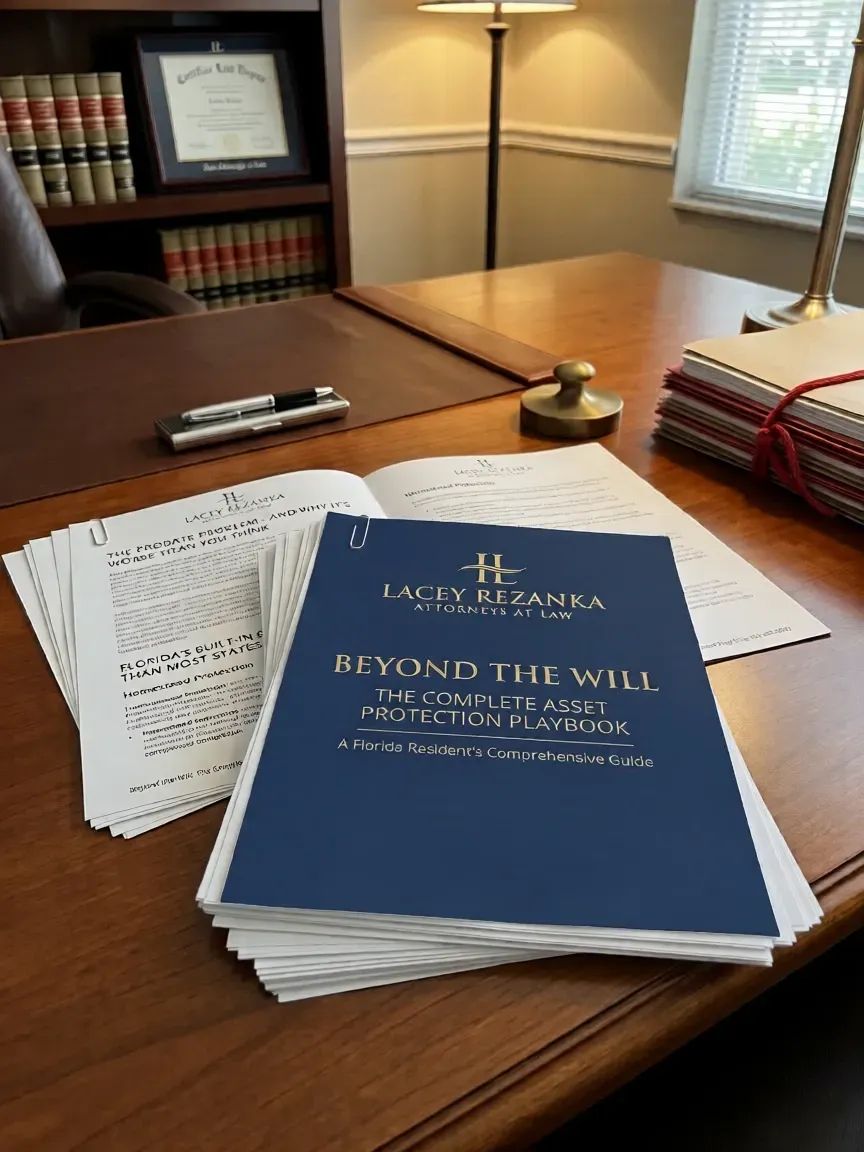
The gap is almost never a missing document
When we review an existing plan, the documents are usually fine. What has slipped is everything around them.
A trust only works if it was funded. Funding means the deed, the accounts, and the entity interests were actually retitled into the name of the trust.
A trust that was never funded is a document in a binder. Those assets still go through probate, exactly as if the trust did not exist. It is the most common planning failure we see, and it happens to people who did everything right up to the last step.
That is what a confidential asset protection assessment is for. It starts with what you own and how each piece is titled, not with which documents you have.
What the assessment does differently
Starts with titling and funding, before it looks at documents
Maps what Florida already protects at no cost: homestead, tenancy by the entireties, retirement accounts
Finds where those protections stop: vehicles, brokerage accounts, boats, business interests, out-of-state property
Tells you honestly when the plan you have is in better shape than you thought
What is inside the guide
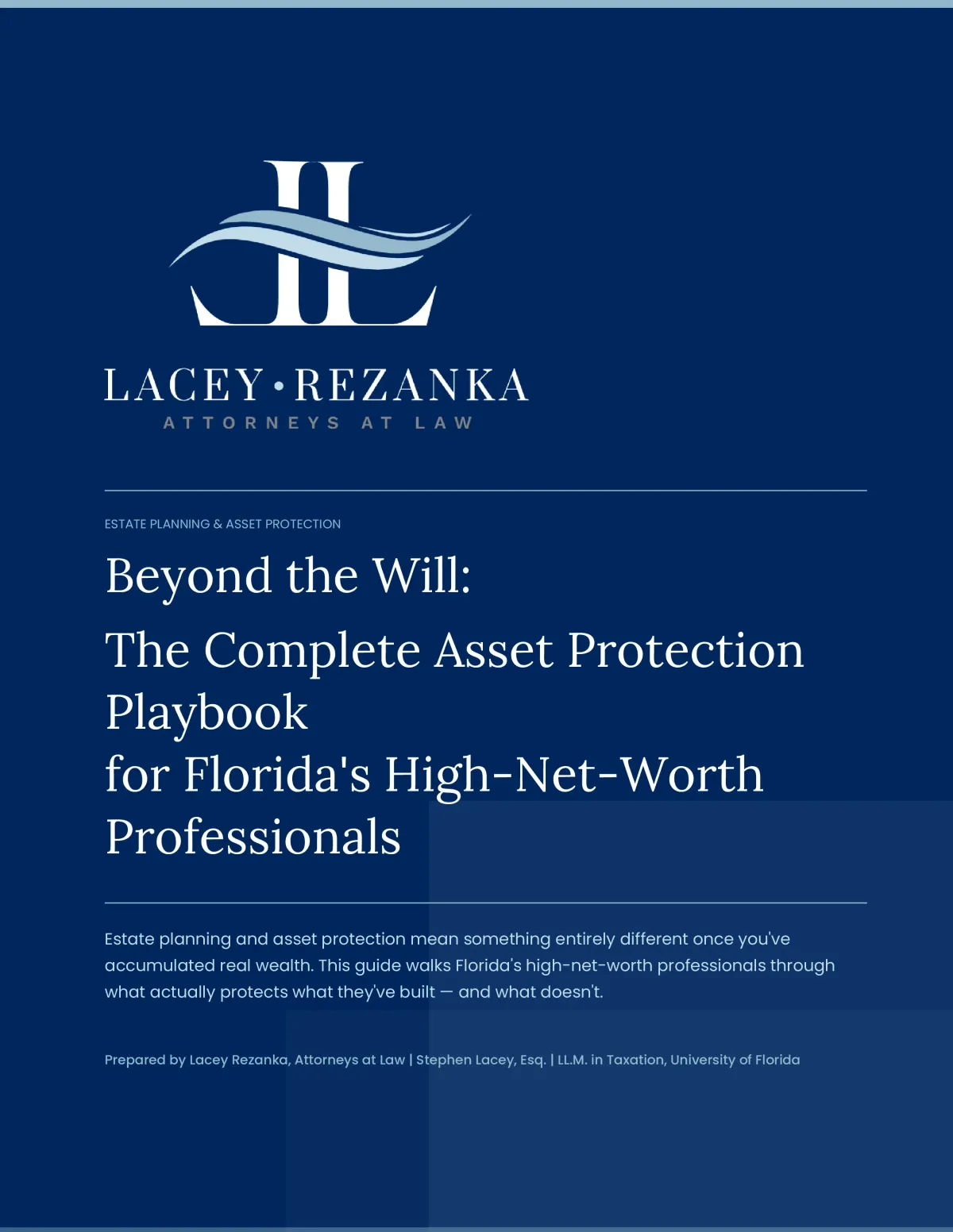
Beyond the Will: The Complete Asset Protection Playbook for Florida's High-Net-Worth Professionals. Ten short sections, written for Florida law.
The five documents every Florida plan needs, and what each one actually does
Why probate can cost 3 percent of the estate, and what that looks like on a $3 million portfolio
Florida's three automatic protections: homestead, tenancy by the entireties, and retirement accounts
Where those protections stop, and which assets are left sitting outside them
Why a single-member LLC protects less than most owners assume
What you give up inside an irrevocable trust, and what you keep
The fraudulent transfer line, and why timing decides which options are still open
What happens after you download it
No calls out of nowhere and no pressure. Here is the whole sequence.
1
The guide arrives
It lands in your inbox within a minute or two, as a PDF you can keep.
2
Read what applies
Ten sections. Skip the ones that do not describe your situation.
3
Tell us where you stand
If you want a closer look, a short questionnaire covers what you own and what you already have in place.
4
A confidential assessment
We walk through your titling, your exposure, and the gaps, and tell you honestly whether you need anything at all.
1
The guide arrives
It lands in your inbox within a minute or two, as a PDF you can keep.
2
Read what applies
Ten sections. Skip the ones that do not describe your situation.
3
Tell us where you stand
If you want a closer look, a short questionnaire covers what you own and what you already have in place.
4
A confidential assessment
We walk through your titling, your exposure, and the gaps, and tell you honestly whether you need anything at all.
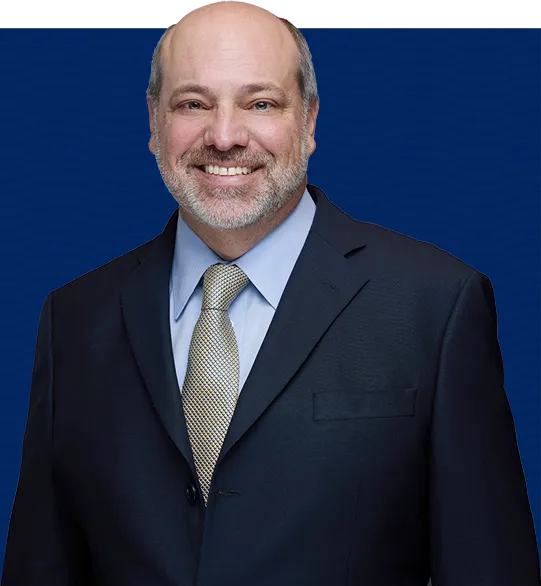
Stephen Lacey, Lacey Rezanka Attorneys at Law
I have practiced law in Florida for more than twenty five years. Most of that work is with people who built something, then found out later that nobody had checked whether the structure around it still held.
Asset protection is not one document. It is titling, entity structure, beneficiary designations, and timing, working together. Estate planning should be a living thing that changes as the law changes and as your net worth changes.
I wrote this guide because the same handful of gaps come up in almost every review. Most of them are inexpensive to close while nothing is happening, and expensive or impossible to close once something is.
More than 25 years practicing law in Florida
Estate planning, asset protection, probate, and trust administration
LLM in Taxation
Host of 321 Legacy Liftoff, the firm's podcast for Florida families
Questions people ask before they get in touch
I already have a will and a trust. Is this still relevant?
Usually more relevant, not less. Most of the gaps in this guide show up in plans that were done properly and then quietly stopped matching the assets. Funding, titling, and beneficiary designations are the first things we check on an existing plan.
I am not wealthy enough for estate tax to matter.
Under current law, federal estate tax does not become a pressing concern until combined assets approach roughly $15 million per person. Asset protection has nothing to do with that threshold. A claim does not check your net worth first.
Does downloading the guide obligate me to anything?
No. It arrives by email and it is yours to keep. If you want to go further there is a short questionnaire, and whether you fill it in is entirely your call. Reading this page and submitting this form do not create an attorney-client relationship.
Is an irrevocable trust giving up control?
Less than most people assume. Depending on how it is structured you may keep the ability to change trustees, redirect assets among beneficiaries, receive income, and direct how the assets are invested. What you give up is unrestricted access to principal, which is the part that makes the protection work.
Something is already happening. Is it too late?
It depends where you are. Asset protection works on a pendulum. While no claim exists the full range of tools is available, and once a claim appears, moving assets can be treated as a fraudulent transfer and clawed back by a court. If you are already dealing with something, say so and we will tell you what is still on the table.
Do you only work with people in Brevard County?
Our office is on the Space Coast and most clients are in Brevard and Indian River. We work with clients across Florida, and the guide is written for Florida law, so it applies wherever in the state you are.
Find out where the gaps are
Beyond the Will is free, it takes one email address, and it is written for Florida law rather than general advice.
If the answer turns out to be that your plan is in good shape, that is a useful answer too.
Where should we send your copy?
Your information stays with our office. We never sell it or share it.
ATTORNEY ADVERTISING. This page is an advertisement for legal services. Stephen Lacey is responsible for the content of this page.
The information here is general and educational. It is not legal advice and it does not address the facts of your situation.
Reading this page, downloading the guide, or submitting this form does not create an attorney-client relationship. That relationship begins only when we have both signed a written engagement agreement.
Lacey Rezanka Attorneys at Law. Licensed to practice in the State of Florida. 6013 Farcenda Pl, Suite 101, Melbourne, FL 32940
By providing a mobile number you agree to receive text messages from Lacey Rezanka Attorneys at Law about your request. Message frequency varies. Message and data rates may apply. Reply STOP to opt out, HELP for help. No mobile information will be shared with third parties or affiliates for marketing or promotional purposes.